
About Evaluation Trakker
Evaluation Trakker is a set of practical tools, templates, and guided learning experiences designed to help professionals produce training evaluation results that remain credible under real-world conditions.
Most evaluation approaches weren’t designed for these kinds of constraints — messy data, limited sample sizes, imperfect benchmarks, stakeholder pressure, and unclear attribution. Evaluation Trakker was built specifically for those conditions.
The focus is not on academic perfection. The focus is on defensible conclusions: results you can explain, justify, and stand behind.
Evaluation Trakker also helps teams standardize how evaluation is done across programs, making it easier to compare results across courses, track outcomes over time, and build an internal measurement system that stays consistent — even as programs and stakeholders change.

Helping clients turn evaluation into credible, stakeholder-ready insight.
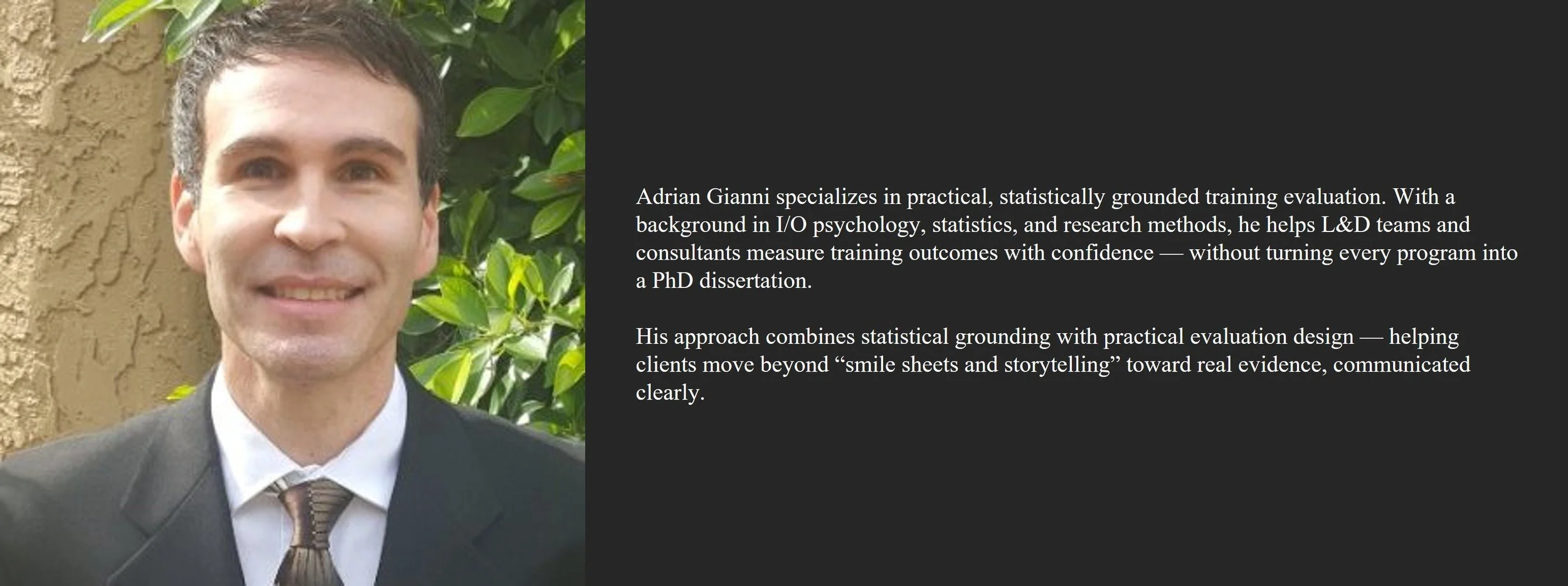
About Adrian Gianni
Guest Speaker Engagements
Invite Adrian to present on modern, defensible training evaluation.
These sessions are designed for professional associations, internal L&D teams, and consultant networks. Topics focus on practical evaluation design, common measurement pitfalls, and what it actually takes to produce credible conclusions — under real-world constraints.
Who These Sessions Are For
Guest Speaker Engagements are a great fit for:
Professional associations (ATD chapters, OD networks, HR groups, etc.)
Internal L&D teams and learning leaders
Consultant communities and boutique firms
Measurement, analytics, and performance improvement audiences
What Audiences Can Expect
These sessions are designed to be:
Practical and example-driven (not theory-only)
Clear and structured (no jargon overload)
Focused on defensibility — not perfection
Relevant to the data most organizations actually have
Immediately useful for improving evaluation decisions
Suggested Speaking Topics
Below are a few high-impact topics that can be delivered as standalone sessions or tailored to your audience:
1) Why Most Training Evaluations Fail (and What to Do Instead)
A clear, honest look at the most common breakdowns in evaluation — and a realistic path to stronger conclusions.
2) Stop Relying on Smile Sheets as Evidence: What L1 Can (and Can’t) Tell You
How to use reaction data appropriately, avoid overclaiming, and build a better measurement strategy without throwing L1 away.
3) Correlation Does Not Equal Impact: Avoiding False Conclusions in Training Evaluation
A practical session on how easy it is to misinterpret results — and how to build evaluation logic that holds up under scrutiny.
4) The Defensibility Standard: What Stakeholders Actually Need to Trust Results
A stakeholder-centered approach to evaluation: how to frame findings, communicate uncertainty, and avoid the “hand-wavy ROI” trap.
5) How to Use the Data You Already Have to Produce Defensible Evaluation Results
A realistic talk focused on extracting value from existing operational data, post-training metrics, and imperfect datasets.
Format
Most guest sessions are delivered as:
45–60 minutes (presentation)
Optional 10–15 minutes (Q&A)
Virtual (Zoom or your preferred platform)
If Your Audience Wants to Go Deeper
Many organizations use guest sessions as a starting point — then continue with:
a Live Webinar (identify evaluation gaps using the CAM framework)
a Guided Workshop (apply a structured evaluation process step-by-step)
or selective Advisory & Consulting for advanced or high-stakes evaluation needs
Request a Speaking Engagement
If you’d like to invite Adrian to speak, send a brief note including:
your audience type and estimated size
preferred date/time range
the topic(s) you’re most interested in